


HOW WE MEASURE SUSTAINABILITY PAGE
ONEarth utilises a set of criteria to assess the needs of our customer to find the best sustainable option, rather than adopt a “one size fits all approach”. By leveraging this assessment tool, we can filter out transient trends and offer solutions that are genuinely sustainable, while also consulting with our customers to identify the best options tailored to their specific applications and needs. This ensures that sustainability is integrated into every stage of the product lifecycle, from design to disposal.
Our three-tier approach to sustainability
ONEarth products are categorized into three sustainability tiers to help our customers understand the environmental impact and make informed decisions:
⦁ ONEarth Gold: The gold standard in sustainability, utilizing the most eco-friendly materials available and ensuring an end-of-life transition that maximizes recyclability or biodegradability for the best outcome for the planet.
⦁ ONEarth Silver: Our second-tier sustainable solution, still prioritizing significant environmental benefits and responsible material choices without compromising on performance.
⦁ ONEarth Bronze: Sometimes, trade-offs are necessary to meet functionality requirements, and this category balances sustainability with practical needs, offering a responsible option when absolute sustainability is not feasible.
Through these rankings and our rigorous assessment process, we aim to promote environmental responsibility and help our customers choose products that align with their sustainability goals
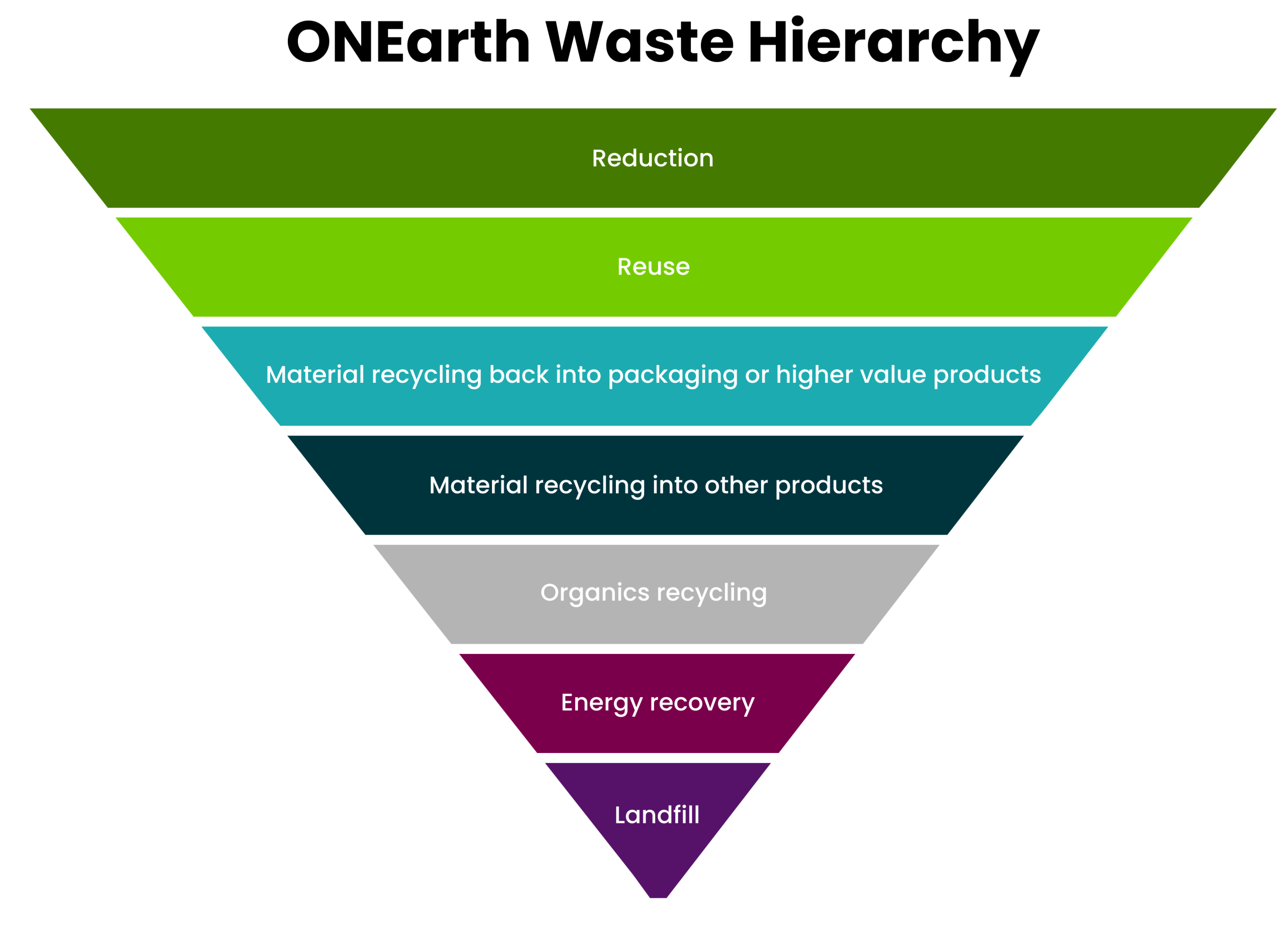
ONEarth Waste Hierarchy
The sustainability impact of a product extends beyond its production; the end-of-life phase is a crucial consideration when determining the most effective solutions.
In developing packaging options, ONEarth adheres to the Sustainable Packaging Guidelines (SPGs) while implementing the Waste Hierarchy established by the Australian Packaging Covenant Organisation (APCO), which emphasizes reduction and circularity over single-use practices.
As part of our commitment to a circular economy, ONEarth prioritizes recycled content whenever feasible. We believe that utilizing recycled materials is vital for fostering end markets for recycling, thus contributing to a genuine circular economy.
| STAGE | Measurement |
|---|---|
| Raw Material Inputs | We evaluate whether raw materials are renewable, recycled, or biodegradable, prioritizing those with the lowest environmental impact. |
| Manufacturing Processes | Assessment of the manufacturing process and facility with a preference for factories utilizing renewable energy and environmentally friendly practices. |
| Design and Life Cycle | Consideration of product durability, reparability, and potential for reuse or recycling at end-of-life. The design should facilitate circular economy principles. |
| End-of-Life Management | Assessment of reuse, recyclability, composability, or biodegradability at end of life. The weighting of importance on this criterion can be impacted by both the product requirements and also state and Commonwealth regulations. |
| Social Impact | Consideration of labour practices, fair wages, and ethical sourcing throughout the supply chain. |
| Certification and Standards | Validation that the product and its components are certified and assessed to relevant standards including Composting standards AS4736-2006 and AS5810-2010, FSC certification and social compliance standards such as SMETA, BSCI at a manufacturer level. |
| Innovation and Continuous Improvement | Incentivize the integration of new sustainable materials, technologies, and practices that improve environmental performance over time. |
This comprehensive scorecard provides transparency and guides continuous improvement, enabling our customers to make informed decisions aligned with their sustainability goals.


Start Your Sustainable Journey
Why This Matters
Doing right by the planet doesn’t have to be complicated. With so much greenwashing, finding what’s truly sustainable can be tricky. At ONEarth, we cut through the noise—evaluating every product against clear, fact-based criteria and tailoring solutions to your needs. Truth over trends, always.
